Chapter 1 · The Spilled Coffee
A morning of small failures. The first whisper from a tired body.
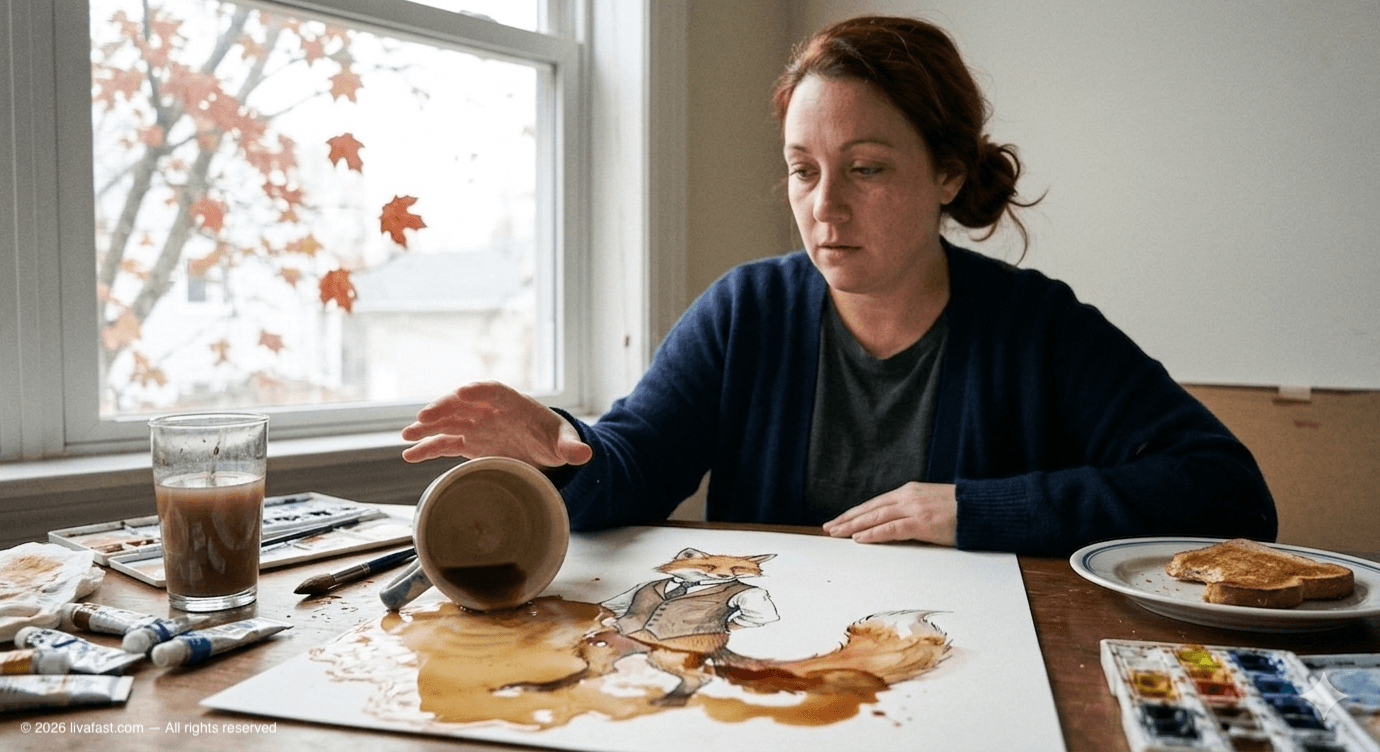
The cup tipped before Ellie understood her hand had let it go.
She watched the coffee fall the way one watches a small, predictable disaster — a child's tower of blocks, a soap bubble brushing a ceiling fan — with a strange, suspended calm. The mug struck the desk. The coffee leapt. A brown lake, edged with cream, spread itself across the watercolor of a fox she had been working on since six that morning. The fox's tail, painted in nine careful layers of burnt sienna, drowned first.
"Oh," Ellie said, softly. Then, louder: "Oh."
Sophie looked up from the kitchen table, where she was eating a bowl of chocolate cereal and reading a book about narwhals. She was ten years old and had inherited her mother's pale, freckled face and her father's enormous, serious eyes. "What happened?"
"Nothing, baby." Ellie was already at the sink, pulling at paper towels with the urgency of a woman trying to outrun a fire. "Mom just spilled."
"On Mister Fox?"
"On Mister Fox."
Sophie made a small sound of sympathy and went back to her book.
Ellie pressed paper towels to the painting and lifted them away gently, the way the obstetrics nurse had once lifted Sophie from her chest to weigh her. Pulp came off in soft, ruined sheets. Beneath the paper, the fox was a smear. Six hours of work. Three weeks until deadline. She closed her eyes.
It was eight-forty-three in the morning on a Tuesday in October. Outside her studio window — which was really just the window of the apartment's second bedroom, the one with bad light and good rent — a maple tree was throwing off its leaves like a person undressing for bed. Ellie was thirty-nine years old. She weighed one hundred and ninety-eight pounds, which she knew because she had stepped on the scale at her annual checkup the previous spring and watched the digital readout with the same disbelief one feels when a stranger claims to know your name. She had not weighed herself since.
She had stopped buttoning jeans in March. She wore leggings now, the way other women wore jewelry — every day, in different colors, as if it were a choice and not a surrender. Her bras had begun to leave red trenches on her ribs. She slept badly. She woke at two and at four and sometimes at six, feeling, beneath her right ribcage, a small, dull ache she had decided was nothing. Probably gas, she told herself. Probably stress. Probably a deadline. There was always a deadline.
Mister Fox Goes to Market was the third book in a series she had been illustrating for six years. Mister Fox was a fashionable, gluttonous, charming creature who, in each book, learned a small lesson about restraint — not too much candy, Mister Fox; not too many pies, Mister Fox; not too many silver spoons, Mister Fox — and then was rewarded, on the final page, with a single, perfect plum. Ellie had drawn him a thousand times. She had drawn his smug little smile and his neat black paws and the faint roundness of his belly, which she had been instructed by the editor to keep cute, not concerning. We don't want him to look unhealthy, the editor had written. Just well-fed.
Ellie had laughed, alone at her desk, when she'd read that note.
She blotted the painting one last time and gave up. The fox would have to be redone. She turned away from her desk and put her hand, without thinking, against the right side of her abdomen, just under the curve of her last rib. The ache was there, the way it had been there for — she stopped, in her own mind, to count, and the count startled her. Months. Six months, maybe. Maybe more.
"Mom," Sophie said.
"Yeah, baby."
"There's a piece of paper in your hair."
Ellie laughed despite herself. She pulled the paper towel out and balled it up and threw it into the trash, and as she crossed the kitchen toward her daughter, she felt — briefly, distinctly — a wave of dizziness so soft it was almost not there. She put her hand on the counter. She breathed. It passed.
"You're tired," Sophie said. It was not a question. Sophie often said sentences like this, sentences that were diagnoses dressed as observations. You're tired. You're sad. You're not eating breakfast. The seriousness of her daughter's attention sometimes made Ellie want to hide.
"I'm fine, peanut. Eat your cereal."
"You're not eating breakfast."
"I'll eat at the studio."
This was a lie. Ellie did not eat breakfast. She drank coffee, and at ten-thirty, when her stomach began to hollow, she walked the three blocks to the corner shop and bought a glazed donut, which she ate on the way back. Sometimes two. The first donut never quite arrived; she would be eating it and looking at her phone, and by the time she set the phone down, the donut was gone, like a thought she hadn't finished. The second donut, she felt.
By eleven, she was at her desk again, redrawing the fox. By noon, her stomach hurt — not with hunger, but with the sweet, dragging ache of a thing that had been fed too quickly. By one, her eyes had begun to close. She lay down on the couch in the corner of her studio, the one she had bought at a garage sale for forty dollars, and she slept.
She did not mean to sleep. She slept for two hours.
When she woke, the light had shifted, and Sophie was home from school, and Mister Fox was still ruined, and her right side was throbbing, dully, like a small drum she could not quiet.
"Mom," Sophie said from the doorway. "Can we have pizza?"
"Yes," Ellie said. "Of course."
She paid for the pizza in cash because the credit card had been declined the week before and she had not yet had the energy to call the bank. They ate on the couch. Sophie pulled the pepperoni off her slice and arranged it in a circle on her plate before eating it, the way she always did. Ellie ate three slices, and then a fourth, and the fourth was a slice she did not want and did not enjoy and could not, afterward, remember tasting.
"Bedtime, peanut."
"Will you read?"
"Of course."
She read her daughter a chapter of Charlotte's Web. She read the part where Wilbur learns he is going to be killed for Christmas dinner. Sophie's eyes grew wet, then steadied. He's going to live, though, Mom, right? Because of Charlotte. Right?
"Right, peanut. He's going to live."
Ellie kissed her daughter on the forehead. She turned out the light. She stood in the hallway for a long moment, her hand pressed beneath her right rib, feeling the slow, patient throb of a body she had stopped thanking a long time ago.
She did not yet know the word for what was wrong with her. She did not yet know about the slow, silent gathering of fat in the small, hardworking organ behind her ribs. She did not yet know that her body, exhausted and faithful, had been writing her letters for months, in the language of dizziness and aches and afternoons that disappeared into sleep, and that she had been throwing the letters away unopened.
She only knew that she was tired in a way that sleep could not fix.
She went to her room. She did not turn on the lamp. She lay down in her clothes, and she put her hand against her side, and she listened to her own breathing, which was shallower than it should have been. Outside, the maple tree dropped another leaf, and another, and another.
In the small, soft dark beneath her ribs, her liver, faithful and afraid, kept her alive a little longer.
Track this in LivaFast
Your FIB-4 score updates automatically from your labs.
