Chapter 13 · Marcus's Visit
Her brother brings a pizza. They tell each other the truth.
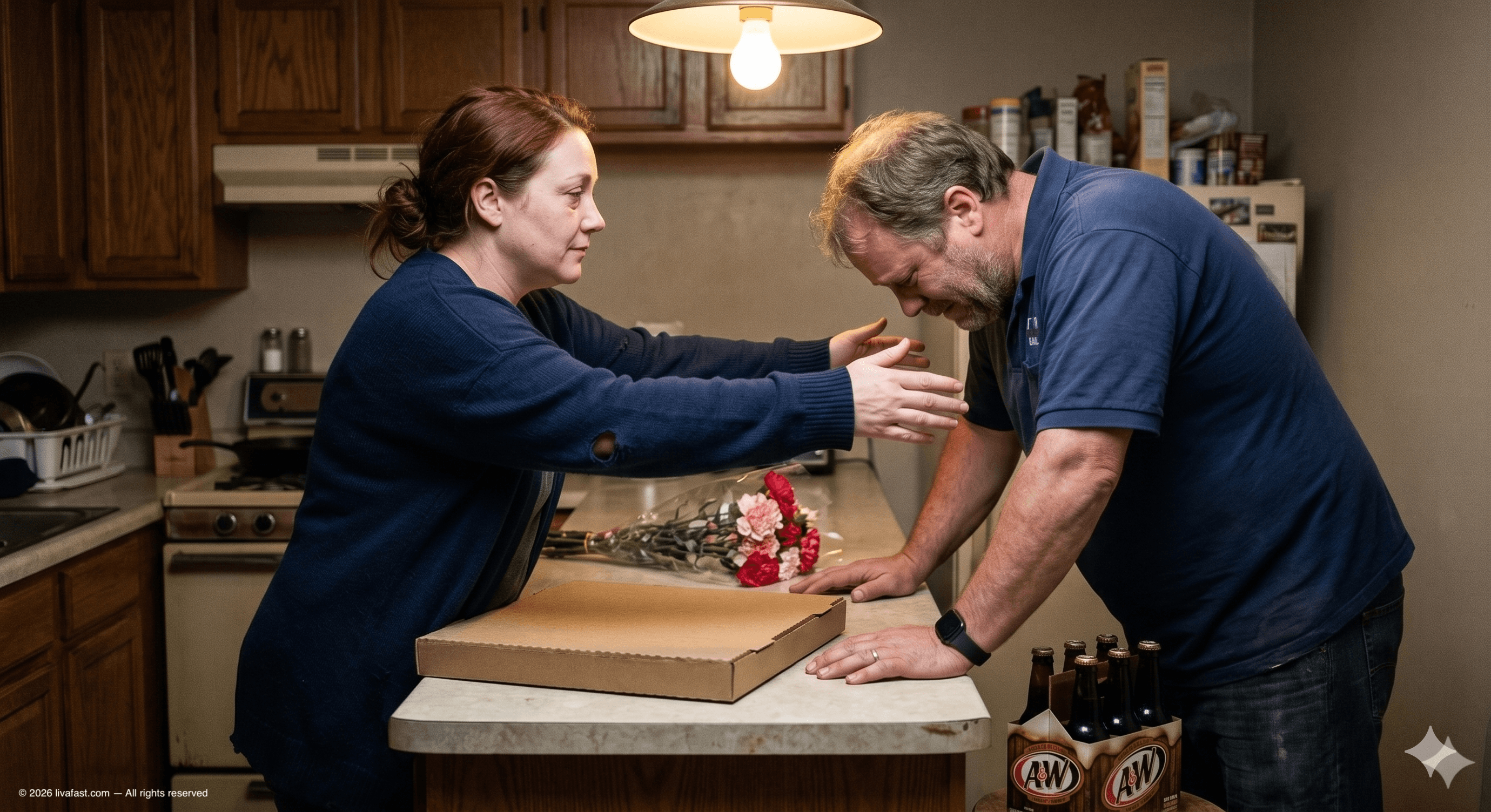
He came on a Friday, with a pizza, and a six-pack of root beer, and a small bouquet of carnations from the floral aisle of the grocery store he managed.
"Thought you could use cheering up," Marcus said, when she opened the door. He held up the pizza like a peace offering. He held up the root beer with the other hand. The carnations he held under his arm because he had run out of hands. He was forty-three years old and stood six feet two and weighed, that evening, two hundred and seventy-one pounds, and his face — the soft, sweet, slightly-sweaty face of a man who had been her older brother all her life — was creased with the apologetic worry of a person who has come to perform care without quite knowing what care looks like.
"Hi, Marcus."
"Hi, El."
She let him in. She did not, immediately, tell him about the pizza.
Sophie came running. "Uncle Marcus!" Marcus knelt — slower than he had, even a year ago — and Sophie threw her arms around his neck, and Marcus closed his eyes for a long second and held her. Ellie, in the kitchen doorway, watched her brother hold her daughter, and felt, for a long, suspended moment, the same complicated tenderness she had felt watching Sophie take a bow at the recital.
"You hungry, peanut?" Marcus said into Sophie's hair.
"Always."
"I brought pizza."
Sophie looked up. She looked at her mother. The look on Sophie's face — at ten years old — was the look of a child who had, in the past week, watched her mother throw out a kitchen and start a fasting timer and walk three blocks to a bench, and who understood, with the swift moral clarity of children, that pizza on a Friday night was no longer a simple matter.
"Marcus," Ellie said. "Can I talk to you in the kitchen?"
She did not, on impulse, want to perform the conversation in front of Sophie. She wanted to hear it first.
In the kitchen, with the pizza box on the counter between them, Ellie said, "I have to tell you something."
"Did Mom call you about her insurance? I told her —"
"No. About me."
Marcus's face changed. He set the carnations down on the counter, very gently, the way a man sets down something fragile.
"What?" he said. "El. What."
"I have fatty liver disease."
There was a pause. Marcus looked at her.
"Like — like Dad had?"
"Dad's was alcoholic. Mine's metabolic. They call it MASLD now. Used to be NAFLD."
"Are you —"
"Reversible. Caught it early. No fibrosis. No scarring. But — yes. It's serious. I have to change my life."
"How serious."
"My liver enzymes were three times normal. My triglycerides were almost three hundred. I'm pre-diabetic. They saw fat infiltration on the ultrasound."
Marcus put both his big, soft hands on the counter. He bowed his head. He did not look at her. For a long minute he did not say anything, and Ellie watched her brother — watched the slope of his shoulders, the rise and fall of his back, the place at the back of his neck where, when they were children, he had always had a small, pale scar from a bicycle fall when he was eight — and she felt, with a sudden clarity, that she had not really seen him in years either.
"El," he said, finally.
"Yeah."
"I have to tell you something too."
"Okay."
He looked up. His eyes were wet. "They told me I was pre-diabetic in March."
"Marcus."
"I haven't told anyone. I haven't told Mom. I haven't told you. I haven't told — I haven't told myself. The doctor said I had to lose forty pounds and I — I went home and I made a steak."
"Marcus."
"I know."
"Marcus, look at me."
He did. He was crying, openly, in a kitchen with a pizza box on the counter and a small bunch of grocery-store carnations beside it, and he was forty-three years old and her older brother and the man who had, at her wedding, walked her down the aisle in the absence of their dead father, and he was crying.
"I am so tired, El."
"I know."
"I am so tired, and Carla is gone, and the boys won't visit, and I go home and I eat and I watch TV and I eat and I watch TV and I sleep, and I wake up, and I drive to the store, and I work, and I drive home, and I eat, and I watch TV, and El, I am — I am dying. I am dying slowly. I know I am. I have known for a long time. I just — I just didn't know how to —"
She crossed the kitchen. She put her arms around him. He was bigger than she was, and softer, and he smelled of his store — of cardboard and the faint, cold smell of refrigeration — and he leaned, helplessly, into her shoulder, and the two of them stood there in the small kitchen for a long time.
"Marcus," she said, into his shirt. "I am going to do this. I am going to figure this out. I want you to do it with me."
"I don't know how, El."
"Neither do I. That is exactly the point."
She pulled back. She wiped his face with the side of her hand — the way she had wiped his face when he was twelve and she was eight and he had crashed his bike into a hedge — and she said, "Sit down. I'm going to make you a salad. The pizza's going home with you for the boys. I'm going to put it in the fridge for them. You and I and Sophie are going to eat what I eat tonight."
"Which is what."
"Spinach. Two pieces of grilled chicken. A baked sweet potato. And a glass of water."
"That sounds —"
"Boring? Yes. Eat it anyway."
Marcus laughed, once, through his nose, and the laugh broke into a small, embarrassed cry, and then back into a laugh.
"Sophie!" Ellie called. "Set the table for three."
Sophie, in the doorway — who had, of course, been listening — said, "I already did."
They ate at Ellie's small wooden table. The chicken was a little dry. The sweet potato was very good. The salad was a salad. Marcus ate everything on his plate. He did not, at first, finish the spinach, but Sophie, with the relentless moral authority of a fourth-grader, looked at him over the rim of her water glass and said, "Uncle Marcus. The spinach has iron." Marcus ate the spinach.
Afterward, on the couch, with Sophie reading on the rug beside them, Ellie pulled out her phone. She showed Marcus the app — the ring, the score, the small kind sentences. She showed him the food log. She showed him the coach.
"I am going to send you the link," Ellie said. "You don't have to download it. But — you might."
"You really doing this."
"I really am."
"For how long."
"For the rest of my life, Marcus."
He looked at her. The man who had been her older brother all her life looked at her, on a Friday night on her secondhand couch, and she watched in his face the small, old shift of a person deciding something he had been refusing to decide for a long time.
"Okay," he said. "Send me the link."
She sent him the link.
Marcus did not, that night, download the app. He went home with the leftover pizza and a half-pound of grapes Ellie pressed into his hands at the door. He drove to his apartment in the dark, and he sat in his car for fifteen minutes before he went inside, and he downloaded the app at eleven-oh-four, with the engine off, in the parking lot of a building where a single window above his car was lit yellow against the night.
He typed in his weight honestly.
He set his fasting window for twelve hours.
He did not eat the pizza.
Track this in LivaFast
Your FIB-4 score updates automatically from your labs.
