Chapter 16 · Beatriz's Kitchen
A widow teaches her to cook with herbs, with patience, with grief.
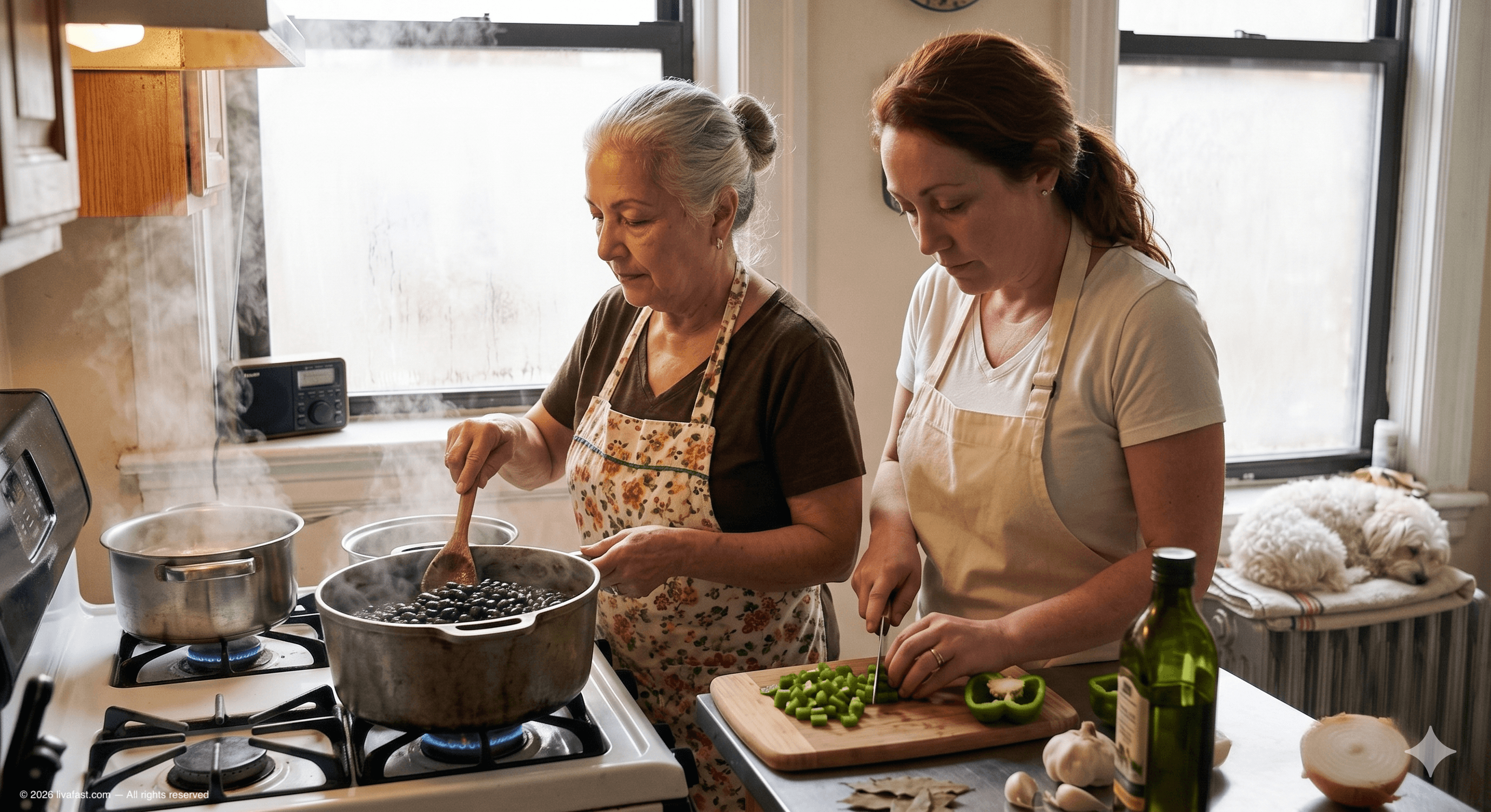
Beatriz cooked on Saturdays the way some people pray.
She would call Ellie, on a Friday night, and say only, "Tomorrow. Eleven o'clock. Bring a knife." Ellie would walk down the street, on a Saturday morning, with a small wrapped chef's knife in her bag, and she would arrive to find Beatriz in a flowered apron in front of a stove that had four burners going, the kitchen window steamed white, the small white dog asleep on a folded towel by the radiator, and a song from the early 1970s — always a song from the early 1970s, always Cuban, always sung by a woman with a low voice — playing from a small radio on the windowsill.
The first Saturday Ellie went, Beatriz taught her to make black beans.
"You think you know how to make black beans," Beatriz said, by way of greeting.
"I know how to open a can."
"That is not how you make black beans, mi'ja."
The beans had been soaking since the night before. They were dry and small, like obsidian pebbles. Beatriz had her chop a green bell pepper, an onion, four cloves of garlic. Small dice, she said. Smaller. Smaller. Like the size of your fingernail. Ellie's eyes ran with the onion. Beatriz handed her a small slice of bread to bite. Hold it in your teeth. The bread takes the tears. The bread, somehow, took the tears.
She watched Beatriz heat olive oil — real oil, Beatriz said, not the kind that comes in the big yellow can, the kind that comes in the small green bottle — and saw her drop the onion, and the pepper, and the garlic into the pot, and stir, and watch them, and stir, and watch them, with a patience Ellie had not, in years, allowed herself in any kitchen. No prisas, mi'ja. No hurry. Cooking is the opposite of hurry.
She added cumin. She added oregano. She added bay leaves. She added the beans and their soaking water and a fresh splash of more water, and she lowered the heat, and she covered the pot.
"Now," Beatriz said. "We sit. We have coffee. We let the beans alone for an hour. They know what to do."
This sentence — they know what to do — would lodge itself in Ellie's mind for a long time. She thought about it in bed that night. She thought about it the next week, walking past Beatriz's bench. They know what to do. She thought about her own body, which she had been treating, for years, as a thing in need of correction, and she thought — slowly, carefully, in a way that took a long time to rise to language — that perhaps her body, too, knew what to do.
Perhaps the only thing it had been waiting for was no prisas.
The lunch they ate together that first Saturday — black beans over a small mound of rice, with diced raw onion and a wedge of lime and a slice of avocado on the side, and a small piece of pan-seared white fish Beatriz had cooked simply, with garlic and parsley — was, Ellie thought, the best lunch she had eaten in fifteen years.
She helped Beatriz wash the dishes. They did not, at first, talk. They moved, side by side, in front of the small sink. Beatriz washed; Ellie dried. The radio played a song, from 1972, about a man who had gone to sea and not come back. Beatriz, scrubbing a pot, sang along under her breath.
"Beatriz."
"Yes, mi'ja."
"How long ago did Hector die."
Beatriz did not stop scrubbing. "Twelve years. Two months. Six days."
"I'm sorry."
"He was a foolish man, mi'ja. He was a kind, foolish man. He could fix anything in a house. He could not fix his own body. He would not look at it. He was so afraid. And when they finally told him he was sick — when the doctor said cirrosis in this very kitchen, this very kitchen, sitting at this very table —" she gestured with the soapy sponge "— he laughed. He laughed, mi'ja. He laughed because he did not know what else to do with the fear. And then he ate the way he had always eaten, and he drank the way he had always drunk, and he died at sixty-one, in a hospital bed, holding my hand."
"Beatriz."
"It is a long time ago."
"Twelve years isn't long."
Beatriz handed her another pot. "No," she said. "It is not."
They were quiet for a while. The dog, in his folded towel, sighed in his sleep.
"Mi'ja," Beatriz said.
"Yes."
"I am going to teach you everything I taught Hector, después. After. Everything I learned, and could not give him, because he was already so sick. I am going to teach you to cook. I am going to teach you to slow down. I am going to teach you that beans, and rice, and fish, and a little olive oil, and an onion, and a clove of garlic — these are not poor people food. These are old food. These are food that the body knows."
"Why?"
Beatriz looked at her. The kitchen window was a square of soft autumn light, and Beatriz's face — small, brown, lined, kind — was a face Ellie was, that day, seeing for the first time as a face that had decided, twelve years ago, to keep loving.
"Because," Beatriz said, "you are walking past my bench, mi'ja. And you are forty years old. And you have a little girl. And I will not — I will not — let another woman lose what I lost."
Ellie did not, this time, cry. She set the dish towel down. She crossed the small kitchen. She put her arms around Beatriz, who was a head shorter than she was, and Beatriz — small, sturdy, smelling of olive oil and bay leaves and something else, something that might have been the faint, dry perfume of carnations — patted her on the back, twice, and then pushed her gently away.
"Bueno," Beatriz said. "Now. The dishes."
That night, Ellie wrote in the app:
Day 27. Fasting window: 14:30. Cooked black beans with Beatriz. Walked home. Slept eight hours. Mood: I do not have words for the mood.
In the food log, where the app, gently, asked her to describe what she had eaten, she wrote: The best lunch of my adult life.
The coach replied: Save the recipe.
She did.
Track this in LivaFast
Your FIB-4 score updates automatically from your labs.
