Chapter 24 · Marcus's Wake-Up
Her brother asks her to teach him. Sunrise walks at the reservoir.
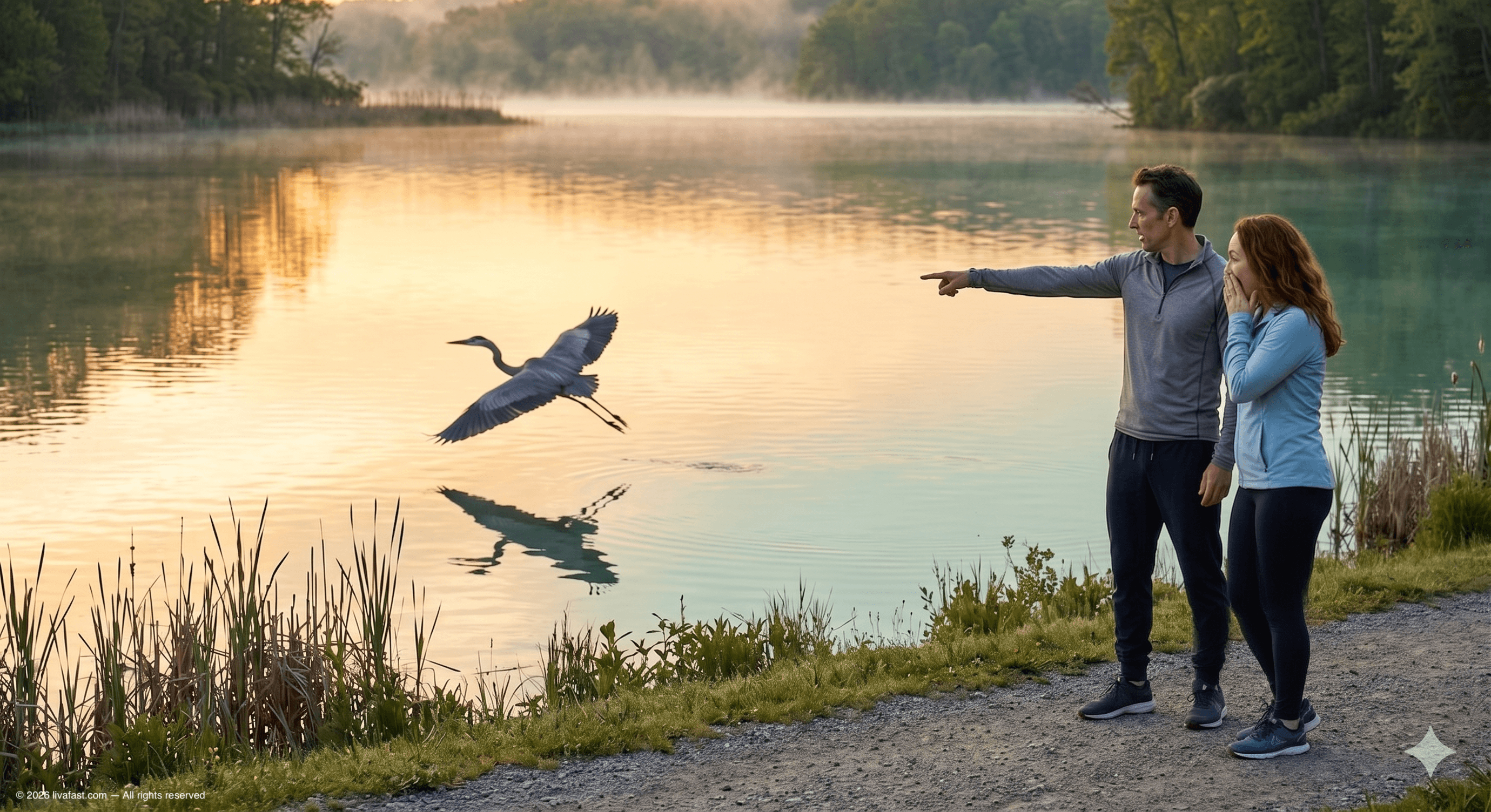
Marcus had been walking, at six in the morning, around the small reservoir on the north side of the city, since the second week of February. He had begun in the dark, in a long puffy coat, in two pairs of socks, with his head down. He had begun afraid that someone would see him. He had walked, the first month, only on the side of the reservoir away from the road, where, he believed, the dog walkers and the runners would not, in the early dark, see his big, tired, two-hundred-and-seventy-one-pound body lumber, and judge.
By April, he had stopped walking on the back side. He walked, as everyone walked, around the whole loop. He nodded at the dog walkers. He moved over for the runners. By May, when his sister called him on a Tuesday morning, he was, by his own admission, not yet a man anyone would call a runner. He was, however, a man who walked four-and-a-half miles every morning before going to manage a grocery store.
He had lost, by the end of April, twenty-eight pounds.
He had not, at any point, told their mother.
This was a quiet, deliberate decision he had made, in early February, when he had not been able to bring himself to say to Mama Rose, I have been pre-diabetic since March of last year and I have done nothing about it until February of this year, and now, at the urging of my younger sister, I am walking and fasting and eating salads for dinner. He had decided, instead, that he would simply, slowly, be different, and that one day Mama Rose would notice, and that one day after that, perhaps, he would tell her. He had not, yet, gotten to one day after that.
On the second Saturday of May, in the parking lot at Beatriz's house, where Ellie had — to Beatriz's enormous, lyrical, weeping joy — delivered the news of the six-month scan, Marcus called Ellie at eleven o'clock in the morning.
"El."
"Marcus."
"I want to ask you something."
"Ask."
"You have been —" he stopped. He started again. "You have been, like, coaching me. I haven't — I didn't say it that way, you didn't say it that way, but. You have. And the — the reservoir thing. The salad thing. The sleeping thing. I — El, I just had a regular doctor visit. Regular. I haven't had a regular doctor visit in eleven years."
"Marcus."
"Listen. My A1c is five-eight. It was six-six in March of last year. My — my doctor used the words clinically not diabetic anymore about me. To me. About me."
"Marcus."
"El, I am asking you something."
"What."
"I want — I want you to do for me, on purpose, what you have been doing for me by accident. I want you to teach me. I want you to tell me, El, what to do next. I am — I am scared to ask you because you are not, like, a — you are not a doctor. But you are — you have been doing this longer than me. You have been — El, you are doing it. The doctors aren't, like, with me at six in the morning. You're with me. Is what I am saying."
Ellie did not, at first, answer.
She was sitting on the small green-painted bench at the corner of Linden and Beech, where she had sat, in November, on her first walk, panting and ashamed. The white dog Pepe was, today, on the porch, watching her without urgency. Beatriz was inside making lemonade — real lemonade, mi'ja, no sugar, two stevia leaves from my balcony pot — and Ellie had walked, in the May afternoon, two blocks down to her own bench because she had needed, after the scan, to sit on it.
She was crying, lightly, when Marcus called.
"Marcus."
"Yeah."
"I — yes. Yes. I will. I want to. I don't — I don't know if I am — qualified, but I am here, and I have been doing this, and I can — I can be with you in it. Yes."
"Tomorrow. Six AM. Reservoir."
"Tomorrow. Six AM. Reservoir."
"El."
"Yeah."
"Why are you crying."
"Because my scan came back. Marcus. The scan I had on Wednesday."
"And."
"It's better. It's much better. The doctor cried. The fat in my liver — it's down to mild. I — I'm — Marcus, I'm reversing it."
There was, on the other end of the phone, a long silence. Marcus was, she could hear, breathing.
"El."
"Yeah."
"El."
"Yeah."
"I am — I am so proud of you. I am so —"
"Marcus —"
"I am so proud of you. I have to — I have to —" He laughed, suddenly, the laugh of a forty-three-year-old man who has been, for a long time, holding something. "El, I have to call Mom."
"Marcus."
"I have to call Mom. Today. I've been — I've been not telling her. About — about me. About all of it. And I can't, anymore. You — you came in. You — I have to. I'm calling her."
"Are you sure?"
"I'm sure. I'm — yeah. I'm sure."
"Okay."
"El."
"Yeah."
"Six AM. Reservoir. I'll bring water. And a banana. I have started bringing a banana on the walks. It's a whole — it's a whole thing now."
"It's a whole thing."
"Yeah."
He hung up.
Ellie sat on the bench for a long minute. Pepe, on the porch, sighed in the May sun. From the open window upstairs of Beatriz's apartment, the radio was playing — something Cuban, something old, something a woman with a low voice was singing about a man who had loved her very much.
The next morning, at five-fifty, Marcus picked her up at her curb in his pickup truck. He was in a clean gray T-shirt that — she noticed — fit him very differently than it had at Christmas. He handed her a small, unopened bottle of water and a banana. They drove, in companionable silence, to the reservoir. They walked the four-and-a-half-mile loop together. He, in the dark before the sunrise, told her about Carla, who had left him three years ago. She, on the path, told him about David, who had left her eight years before. They walked. They talked. They did not, mostly, talk. The sun came up over the small reservoir, and the path turned a soft, pale orange, and a heron — a great blue heron, the only one Ellie had ever seen up close — lifted itself out of the reeds at the far end and rowed, in long, slow, primeval strokes, low over the water.
Marcus stopped on the path. He looked.
"El."
"Yeah."
"Look at that bird, El."
"I see it, Marcus."
"That's — that's a heron, El."
"It is."
"I have walked here every morning for three months and I have never seen one."
"I know."
"What does it mean."
"It doesn't have to mean anything, Marcus."
"I know. I know. I'm just — I'm just saying. Look at that bird."
They watched the heron disappear into the trees on the far side. They walked. Marcus, halfway through the next mile, said, very quietly:
"El. I called Mom last night."
"And."
"She — El, she cried. She — she said —" he stopped. He breathed. "She said she'd known. About me. Of course she'd known. She said — she said she had been afraid to ask, in case it made me dig in. She said she had — she had been waiting, El, for me to tell her. For — for two years."
"Marcus."
"I know."
"I'm glad you told her."
"Me too."
They finished the loop. They drove home. At Ellie's curb, Marcus, in the truck, put both hands on the wheel and did not, immediately, let her out.
"El."
"Yeah."
"I haven't said this in a long time."
"Marcus —"
"I love you, El."
"I love you too."
"I know I haven't been a — I haven't been a good —"
"Marcus. Stop. You have been good. You have been my brother. You came on a Friday night in November with a pizza, and you cried in my kitchen, and you went home, and you downloaded an app in your car at eleven o'clock at night, and you have walked four-and-a-half miles a day for three months. You are good. Don't apologize for what you weren't. You are now. That's the whole — that's the whole thing."
He nodded.
She got out of the truck. She closed the door. He drove, slowly, away.
Inside, in her own kitchen, she made breakfast for Sophie — eggs, a slice of whole-wheat toast, half an avocado — and she made the same breakfast for herself, and she wrote, in the app, in the journal:
Day 215. Walked the reservoir at sunrise with Marcus. Saw a heron. He told Mom. The world is — the world is opening up.
The coach replied: Yes.
Track this in LivaFast
Your FIB-4 score updates automatically from your labs.
