Chapter 26 · One Year — The Letter
She writes to the woman she used to be.
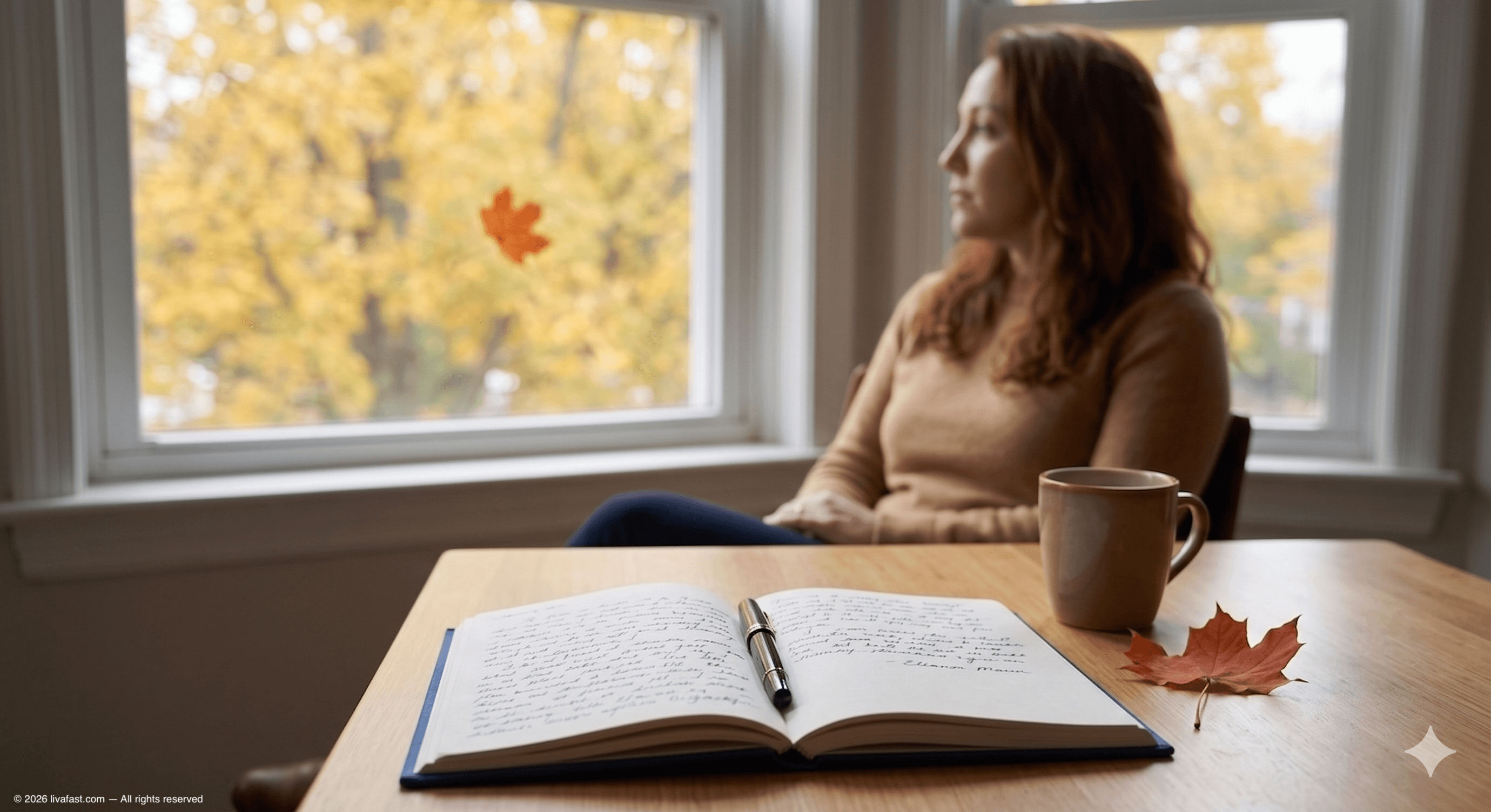
She wrote the letter in October.
It was the morning of the day she had been diagnosed, one year before. The maple at the corner — the same maple, the actual same tree, that had been throwing off its leaves like a person undressing for bed twelve months prior — was, this October, doing the same thing. The light, in her kitchen, was the same gray-gold of a fall morning. The radiator, in the wall behind her, was making the same small, polite knocking sound it had been making for fourteen years.
Sophie was at school. The apartment was quiet. The fasting timer, on her phone, would close at ten — 15:43, sixteen, almost home — and she had decided, in the past week, that on the anniversary of her diagnosis, she would do the only ritual she had ever, in her life, devised for herself.
She would write a letter to the woman she had been.
She sat at the small wooden table. She had a notebook — a plain, hard-cover, blue notebook, the kind one buys at a stationery store and not at a craft store, the kind one keeps for a long time. She had a pen. She uncapped the pen. She wrote, at the top of the first page:
To the Eleanor of one year ago.
She paused. She watched the maple. A leaf — a small, flame-orange one — let go of a high branch and began the long, slow, sideways descent that all maple leaves take. She turned back to the page.
She wrote.
You walked into Dr. Patel's office one year ago today. You were terrified. You did not know what was wrong. You weighed one hundred and ninety-eight pounds. You had not climbed an auditorium stair in years without your heart making a sound you did not recognize. You drank coffee for breakfast. You ate two donuts at ten-thirty. You napped at one. You ate pizza for dinner. You went to bed at midnight. You woke at three and you woke at four and you did not know that this was not how a body was supposed to live.
You were ashamed of yourself. You did not — until the night before that appointment — even look at yourself in a mirror. You had been hiding from yourself for about eight years. You did not want to know what you would see if you looked. You did not believe, that night, that you could begin again. You thought, in the bathroom, with your nightshirt on the bath mat, that you had gone too far in the wrong direction. You thought it was too late. You thought your body had decided, on its own, without consulting you, that it was finished.
Eleanor. It had not.
*I am writing to tell you what happens. I am writing to tell you, because you cannot, that morning, hear it from anyone. I am writing because I want you, that morning, to walk into Dr. Patel's office a little more steadily. I want you, that morning, to be a little less afraid. I want you, that morning, to know that on the other side of this — on the other side of one year, on the other side of all the things you do not yet believe you can do — you will be alive, and you will be well, and you will be, in a way you do not currently believe possible, yourself.
Today, your liver enzymes are normal. They have been normal, on every test, since March. Your fasting glucose is eighty-eight. Your A1c is five-point-two. Your triglycerides are one-twenty. Your HDL is fifty-one. The fat in your liver, on imaging, is graded mild. Your hepatologist, Dr. Reyes, who you have not yet met, has cried in front of you twice. Your weight is one hundred and fifty-eight pounds, and most days you do not know that exact number, because you do not, anymore, weigh yourself often.
You have walked, in the past year, more than a thousand miles. You have done, in the past year, eighty-three hours of yoga. You have completed three hundred and forty-one sixteen-hour fasting windows. You have not, in nearly eleven months, eaten a glazed donut. You have eaten, by your rough count, six hundred and fifty meals that have not contained added sugar. You have not, in nine months, ordered pizza. You have made, in the past year — with a Cuban widow named Beatriz, who you have not yet met — more pots of black beans than you can count. You have learned to bake bread. You have learned to braise fish. You have learned to make a salad of orange and red onion that tastes, at any temperature, of California in March.
You have a daughter. You knew that. But you have, also, a relationship with that daughter that you did not know, that morning, was possible. She has watched you do this, Eleanor. She has watched you wake up. She has watched you walk three blocks the first time and seven blocks the second time and a thousand blocks since. She has watched you cry in front of her. She has watched you not eat a donut. She has watched you not order pizza. She has watched you make herself a sandwich, in your kitchen, when you were tired, and not order delivery. She wrote a school essay last month about the bravest person she knows. She read it aloud at an assembly. The bravest person she knows is you, Eleanor. Do you understand that? The bravest person.
Your brother Marcus has lost forty-eight pounds. He is no longer pre-diabetic. He walks four-and-a-half miles every morning at the reservoir. Sometimes you go with him. He has a girlfriend. Her name is Tessa. She works at the library. She is forty. She makes him laugh in a way you have not heard him laugh since he was twenty-one.
Your mother is alive. She had a hypoglycemic episode in June that scared all of us. She has, since, an at-home aide three days a week and a meal-delivery service we set up. She has lost — without trying — fourteen pounds, simply because the meals that come are not the meals she was, for fifty years, cooking for herself. She calls you on Sundays. She does not, anymore, deny things on the phone. She tells you when she is afraid. You tell her when you are afraid. You are, after all these years, slowly, a little, becoming friends.
There is a man.
His name is Theo. You met him on a trail in April. His wife died of pancreatic cancer two years ago. He is kind. He is steady. He bakes a sourdough loaf so slowly that he begins it the night before he serves it. He does not, on any day, ask you for more than you can give. He has a daughter from before, who is seventeen and lives in California with her mother. He is not, you do not think, the love of your life. He is, instead — and this is more, perhaps, than the love of your life — a companion in your life. Someone who has known a kind of grief, and who walks with you, in May and in October, on a trail you would, two years ago, have been ashamed to set foot on.
Eleanor. The thing I most want to tell you is this. I know — that morning, in November, in the parking lot of Dr. Patel's office — that you are afraid. I know that, in the next eight days, you will hear the word cirrhosis from a doctor and the room will tilt. I know that you will, in those eight days, drive home from a follow-up and feel the pull, hard, sharp, real, of a milkshake at a drive-through. I know you will sit in your car with your hand on your right side and beg a small organ behind your ribs to forgive you. I know that, at the bottom of all of this, in the part of yourself you do not want to look at, you believe that you have wasted twelve years.
You have not wasted twelve years.
The years that came before today were the years that brought you here. The years that brought Sophie into the world. The years that taught you to draw a fox. The years that built, slowly, the muscle of attention — to deadlines, to a ten-year-old's recital, to a Cuban widow's bench — that you would, this year, finally turn back upon yourself. Nothing was wasted. Everything was the long, slow road in.
*Walk into Dr. Patel's office, Eleanor. Sit in the chair. Cry, if you have to. Let the kind nurse hum over your arm. Drive home. Throw out the donuts. Walk three blocks. Sit on a bench. Drink water out of a stranger's mug. Download an app. Set a fasting timer. Sleep. Wake. Try again the next day. Try again the next day. Try again, Eleanor, every day, for one year. The body will hear you. I am here, on the other side, to tell you that the body will hear you.
Don't wait, kid.
Love, Eleanor October 27, the year you got your life back
She put the pen down. She read what she had written. She read it twice. She did not, this time, cry. She had, in this past year, used up — she felt — most of her crying. The letter, on the page, in her own handwriting, was the small, definite document of a year that, on its anniversary, she had, very deliberately, witnessed.
She closed the notebook.
The fasting timer, on the table beside her, made the small wind-instrument note. The ring closed.
Sixteen hours, the screen said.
Welcome back, Eleanor.
She got up. She made breakfast.
Track this in LivaFast
Your FIB-4 score updates automatically from your labs.
