Chapter 28 · Theo and the Sourdough
A loaf, slow-risen, on a birthday. A first kiss in a long time.
Her birthday was on a Saturday in March.
She turned forty-one. She had — she realized, somewhere around two in the afternoon, when Sophie was at a friend's house and the apartment was, briefly, hers — not, in twelve years, celebrated a birthday. She had marked them. She had, at the studio, eaten a piece of grocery-store cake on the day. She had, at home, opened a small gift from Sophie. She had not, in her adult life, had a birthday, in the way that other people sometimes had birthdays — with a meal, and a candle, and a person.
This year, she had decided, she would.
She had asked Theo to make her dinner.
It had been, on her part, a courageous request. She and Theo had been, for nine months, the kind of friends who walked together. The kind of friends who sat, at the trailhead, in their cars, with their windows down, and talked for forty-five minutes longer than they had meant to. The kind of friends who, by November, had begun, occasionally, to text each other small ordinary things — did you walk this morning, the heron is back, my daughter sent a photo of her cat. They had not, in the polite, careful way of two adults who had been, in earlier lives, very thoroughly broken, done anything else. He had not asked her to dinner. She had not asked him to dinner. They had walked.
In February, Theo had begun, on Saturdays, to bring along, on the trail, a small thermos of broth.
He would pour her a cup, at the top of the ridge, and they would drink it, and the broth — he would say, almost sheepishly — was something he had begun, in the winter, to make for himself, on Friday nights, slow-simmered for eight hours. I started baking too, he had said, one Saturday in early March. Sourdough. It's — I think I needed a hobby. It takes a long time. The starter has been alive on my counter since November. His name is Frank.
"Frank," Ellie had said.
"Frank. He bubbles. He is — he is really very alive. I keep him in a Mason jar."
"My birthday is in two weeks."
"Yes?"
"Theo. Make me a sourdough loaf."
He had stopped on the path. He had looked at her. He had, in his face — his lived-in, kind, tired face — done the small, slow shift of a man being asked something he had not, in a long time, been asked.
"Ellie."
"Theo."
"Is that — is that a date."
"Yes."
"You want me to come over and bring you a loaf."
"I want you to come over and bring me a loaf and I want you to stay for dinner and I want you to meet Sophie because you are not, anymore, a stranger, and I want — I want you to know, Theo, that I am asking you this without any expectations beyond bread and dinner, but I am, also, asking you this because it is my birthday, and because I am forty-one, and because I would like you, on Saturday, to be in the kitchen of a woman who has, in the past sixteen months, become a person you might want to be in a kitchen with."
He had, for a moment, looked very still.
Then he had smiled.
"Saturday," he had said.
"Saturday."
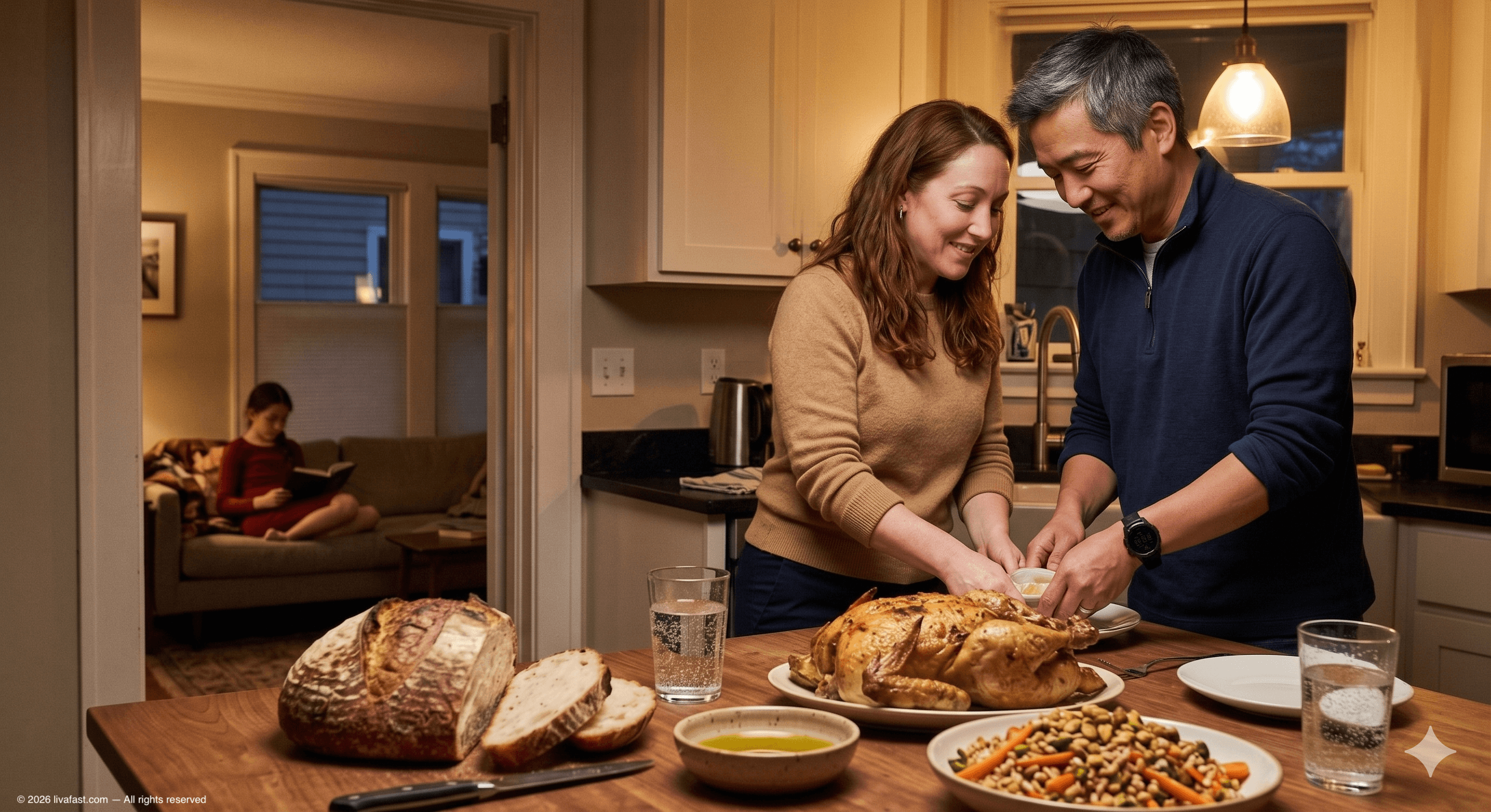
He came at four. He had — he later admitted — been awake since five that morning, shaping a dough he had begun the previous evening. The loaf, when he pulled it from the canvas tote bag, was a round, dark, beautiful thing, with a deep, blistered crust scored across the top in a single confident slash, and a smell — yeasty, dark, faintly sweet — that filled her small kitchen the moment he set it on the wooden table.
Sophie, who had — that week, with great solemnity — agreed to be present at the dinner, came out of her room.
"Hi," Theo said.
"Hi," Sophie said.
"I'm Theo."
"I know."
"I brought a loaf."
"I see that."
"My starter's name is Frank."
Sophie considered this, with the long, slow, evaluating look of a fourth-grader who had, for the past six months, been carefully watching her mother text a man named Theo on Saturday mornings. Then Sophie, with a small, solemn, generous nod, said:
"Frank is a good name for a sourdough."
Theo laughed.
He had, at Ellie's request, brought also: two roasted chickens, a salad of roasted carrots and farro and pistachios, a small pot of olive oil he had infused with rosemary, and — for Sophie — a small pint of strawberry sorbet, which Sophie ate in a bowl at the kitchen table while the adults, at the small wooden table, ate the rest.
The bread. The bread was real bread. The bread was the bread that the words real bread mean. It had a long, slow, complicated taste, a faint sourness, a deep yeastiness, a crumb that pulled apart in long, soft threads. Ellie ate two pieces. She had not eaten bread, much, in sixteen months. She ate it, that night, the way Beatriz had taught her to eat anything: slowly, with attention, with the small, deliberate gratitude of a body that had been allowed to want a thing.
"Theo."
"Yes."
"This is — this is the best bread I have ever eaten."
"The starter is Frank."
"Frank is a marvel."
After dinner, they did dishes together, side by side, in front of the small sink. Sophie had gone to her room with her book. Theo washed; Ellie dried. They did not, much, talk. The radio — which Ellie had, on impulse, turned on — was playing something old, something from the 1970s, something that made her think, for a moment, of Beatriz's kitchen.
When they were done, he turned, with the dishcloth still in his hand, and looked at her.
"Ellie."
"Yeah."
"I haven't — I haven't done this in a long time."
"Done what."
"This."
He gestured, vaguely, at the kitchen, the table, the sink, the situation.
"Theo."
"I'm — I'm not, I don't think, very good at it, anymore."
"I'm not either."
"I — I don't know — what this is."
"Theo. Neither do I."
"I — I love Mae still."
"I know."
"I will, I think, for the rest of my life. Some part. Always."
"I know, Theo."
"I don't want to — I don't want to come into your kitchen pretending I don't."
"I would not want you to."
He nodded. He set the dishcloth on the counter. He put his hand — slowly, carefully — on her arm. She put her hand over his.
"Ellie."
"Yes."
"Can I — can I —"
"Yes, Theo."
He kissed her.
It was a short kiss. It was a careful kiss. It was the kiss of two adults who had been, in earlier lives, broken by people they had loved, and who knew, by the age they had reached, that this kiss was a beginning of something whose shape neither of them could yet, that night, predict. It was a kiss that did not, on his part, feel like a betrayal of a wife he still loved. It was a kiss that did not, on her part, feel like a betrayal of a body that had, one year ago, been almost too tired to climb stairs.
It was, she thought, simply, a kiss.
When he left, at nine-thirty, at the door, with his canvas tote bag in his hand, he said only: Same time next Saturday?
And she said: Same time.
When she closed the door, she went to Sophie's room. Sophie was on her bed, with her book, in her pajamas.
"Peanut."
"Mom."
"What did you think."
Sophie, without looking up, said: "He's nice."
"Yeah?"
"He brings real bread. Anyone who brings real bread is nice."
Ellie laughed. She kissed her daughter on the head. She went to her own room. She lay in the dark, in the quiet bed, and she put her hand on her own ribs, and she said — to nobody, to the small organ behind her ribs, to the year she had just finished, to the year she was just beginning —
Thank you. Thank you. Thank you.
And she slept.
Track this in LivaFast
Your FIB-4 score updates automatically from your labs.
