Chapter 30 · The Open Window
A morning. A garden. A timer ringing softly. A life she chose.
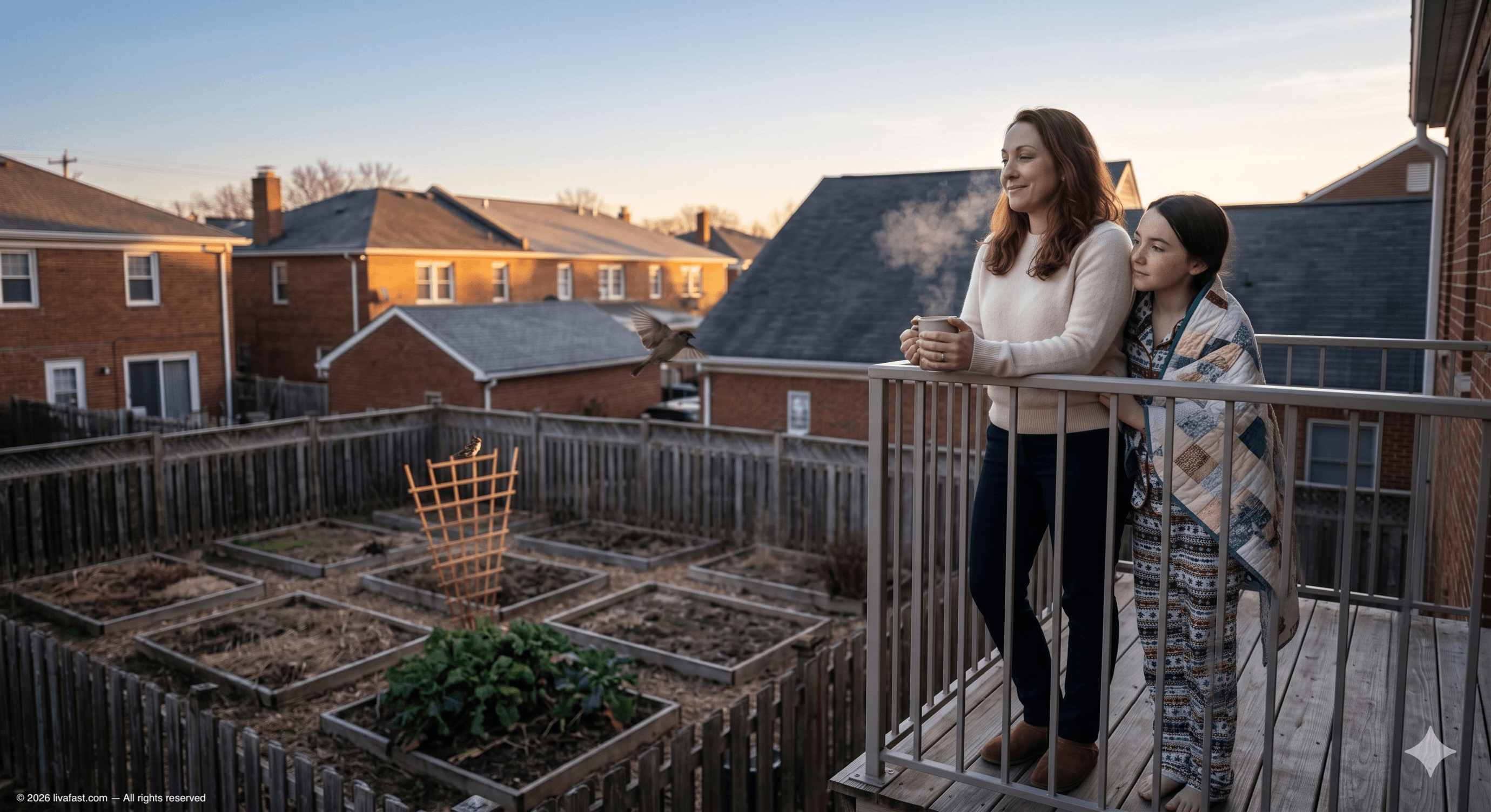
Two years and four months after the spilled coffee.
It was a Saturday in February — but a different Saturday, in a different February, on the other side of a long road. Ellie, who was now forty-one years and four months old, woke at five-fifty in the morning. She woke before the alarm. She woke, in her bed, in a new apartment — they had moved, in October, three blocks over and one floor up, to a slightly larger place with a small balcony off the kitchen — and the window in her bedroom looked out, in the new place, on a small, fenced community garden, twelve plots in a patch of city ground that had, sixty years ago, been a row of derelict garages.
Most of the plots, in February, were brown and dormant. Two of them — Mrs. Anand's, and the Hernández family's — had small, hardy patches of green kale poking up out of the mulch. Ellie had been awarded, in November, a plot of her own. Plot 7. She had not yet planted anything in it. She was, this year, going to plant it with Sophie. They had, on a sheet of paper taped to the refrigerator, a small map of what they were going to put in: tomatoes, basil, sugar snap peas, two rows of carrots, a small triangle of cilantro.
The fasting timer, on her phone, was at 15:42.
Beneath it, on the screen: Eighteen minutes. You're almost home.
She lay still in the bed for a moment. The mattress, beneath her, was the firm one — the new one, still, two years on — and her body, in it, was the body of a woman who had, in the past two years, walked nineteen hundred miles, completed seven hundred and twelve sixteen-hour fasting windows, and made, with her hands, an almost daily breakfast for a child who was, now, eleven going on twelve and lengthening into the long, awkward, beautiful figure of the woman she would, someday, be.
The body, in the bed, was one hundred and fifty-six pounds. Not as a goal. As the place the body had, on its own, settled. The body, in the bed, had a resting heart rate of fifty-eight. The body, in the bed, had — at the ten-month mark — completed its last mandatory ultrasound, and had, at the twenty-month mark, switched to annual blood work, and had, at the most recent visit, been quietly and almost casually told everything looks lovely, Eleanor, see you next year by a Dr. Reyes who had begun, that morning, to wear the small silver hoop earrings Ellie had — at Christmas — sent her in a card that had said only thank you, again, again, again.
She got up.
She did not turn on the light. She walked through the dim hall to the kitchen. The kitchen, in the new apartment, had a window over the sink that faced east. She filled a glass at the sink. She drank it slowly. The garden, outside the window, was a soft, blue-gray rectangle in the pre-dawn.
The fasting timer, on the counter, made the small wind-instrument note.
The ring closed.
Sixteen hours, the screen said.
Welcome back, Eleanor.
She did not, immediately, eat. She made a coffee in the small French press she had bought, in November, to replace the cheap drip machine she had been using for years. While the coffee bloomed, she walked, in her socks, to her studio — the second bedroom, in the new apartment, with the good light, finally, finally — and she sat down at her drawing table.
She uncapped the fountain pen. She had been working, for the past four months, on the final spread of The Quiet Garden Inside Us. She had drawn the heart in red, the lungs in a soft, foggy purple, the gut in a long, looping, friendly tan. She had drawn, with great care, the liver in a shy, ochre gold — the small, faithful organ that is most often forgotten, the manuscript had said — and she had drawn it, with a gentleness she had not, in any previous book, brought to a body. She had drawn, for the last spread, a sleeping child, on her side, with her small palm open against her own ribs.
The last thing the spread needed was the small ring.
She had been, for a long time, afraid of drawing the ring. She did not want it to look like an app icon. She did not want it to look like a piece of marketing. She had wanted, for the past four months, for the ring to look like what it actually was — a small, golden, glowing thing, like a wedding band laid flat, that was somehow finishing, and somehow beginning, and that was, in the spread, hovering — quietly, kindly — over the open palm of the sleeping child, as if to say: something has closed, and something is starting again.
She drew the ring.
She drew it, with the fountain pen, in a single, slow, unhurried curve. It came right, on the first try. She set the pen down. She looked at the spread. The spread — she allowed herself, today, the small private thought — was, perhaps, the best work she had ever made.
The coffee finished.
She poured it.
She walked out, with the cup, onto the small balcony off the kitchen. The morning was cold, but not bitter. The sky, at six-eighteen in February, was the soft pre-dawn blue that, in another life, she had not, often, seen, because in another life, at six-eighteen, she had been asleep, in the soft accumulated valley of an old mattress.
The garden, below her, was beginning to lighten.
She held the coffee in both hands. She did not, this morning, drink. She breathed.
In the apartment, behind her, three people slept.
Sophie was in the bedroom on the right, in the room with the whale poster and the bookshelves and the stack of unread library books on the floor. Sophie, eleven and a half, had — last night — read, until eleven, a novel about a girl who lived alone on an island with a herd of goats. Sophie was, on the bed, on her stomach, with one arm thrown over her own pillow, in the deep, untroubled sleep of an eleven-year-old whose mother had not, in two years, missed a school recital, a science fair, or a single Sunday morning of pancakes.
Mama Rose was in the small guest room off the hall — she stayed, now, every other weekend, after a bad fall in October had finally convinced her to let Marcus and Ellie help her sell the house and move to a small, sunny apartment on the second floor of a building three blocks from Ellie's. She was sleeping, in the guest room, with the door open. Her aide came on the alternate Saturdays. The aide and Mama Rose had become, in the past year, friends — they watched, on Saturday afternoons, an old British television show together, and shared, a Cuban coffee Beatriz had taught them both to make.
Theo was in Ellie's room. He had — in October — moved in three of his shirts, two pairs of running shoes, a French press of his own (they kept it on the second shelf), and the Mason jar with Frank in it. Frank now lived on a corner of Ellie's counter, beside the toaster. Theo had, at Christmas, taken Ellie and Sophie to meet his daughter — Mia, seventeen, at college in California — and Mia had, on the second day, hugged Ellie at the airport with an unfamiliar shyness that had felt, to Ellie, like the start of a friendship she was not yet ready to push. Slow, Theo had said. We are slow. We are, indeed, slow, Ellie had said. We are turtles.
Beatriz was, three blocks west, in the small first-floor apartment she had lived in for forty-six years, asleep, with the white dog Pepe at her feet, in a fishing hat that smelled faintly of the sea.
Marcus was, four miles north, asleep on his side, on a bed he shared with Tessa, with the alarm set for five-fifty. He would, at six, get up. He would, at six-fifteen, be at the reservoir. He had, last week, completed a five-kilometer charity walk in forty-two minutes. He had texted Ellie a photo, at the finish line, with both arms in the air, and had captioned it: El. Look.
Linh was, two miles south, in her studio, on her own mat, doing the slow, gentle, private hour of yoga she did, every Saturday, before her first class.
Below Ellie's balcony, in the garden, in Plot 7, a small sparrow landed on the empty trellis she had, the previous weekend, set up with Sophie. The sparrow, with the small, imperturbable confidence of small birds, looked at her. It hopped along the trellis. It cocked its head.
She raised her cup, in a small, quiet salute.
The sparrow flew.
Ellie stood, on the small balcony, in the cold blue morning, and she felt — beneath her ribs, in the small, faithful organ that had been, for two years and four months, the unspoken center of her life — nothing. Nothing in the bad sense. Nothing in the good sense. The body, this morning, was quiet. The body was working. The body was, in the way of a body that had been given a window and had used it, forgotten, in the small, wonderful way that healthy bodies are allowed to forget themselves.
She did not, this morning, write anything in the app. She did not, in fact — she realized — open it. The ring had closed on its own. The new day had begun on its own. She would, later, log her breakfast, the way she logged her breakfast every day, and she would, later still, take the long walk through the conservation land that she now took, on Saturdays, with Theo and Sophie, where the heron — which had become, over the past year, their heron, the heron of their family — would rise from the pond at the far end and row, in long, slow, primeval strokes, low over the water.
But for now, she did nothing.
She held the coffee. She breathed.
The garden lightened. The blue softened toward gold. A second sparrow joined the first on the trellis. From the apartment, behind her, came the small, unmistakable, padding sound of an eleven-year-old in slippers, walking from her bedroom into the kitchen, in search of a mother she knew, today, would be exactly where mothers are supposed to be on Saturday mornings.
"Mom?" Sophie called, from the doorway.
"Out here, peanut."
"It's cold."
"Bring a blanket."
Sophie came out, in pajamas, with a blanket, and stood beside her mother on the small balcony, and looked, with her, down at the garden. The two of them, side by side, did not, for a long minute, speak.
"Mom."
"Yeah, peanut."
"What are we going to plant first."
"Peas, I think."
"When."
"When the ground thaws."
"How will we know."
"The ground will tell us, peanut."
"Oh."
There was a pause.
"Mom."
"Yeah."
"You're smiling."
"I am, peanut."
"Why."
Ellie thought about it.
"Because," she said, "I am alive. And you are alive. And the garden is going to grow. And — peanut, that is, today, enough."
Sophie leaned, very lightly, against her mother's hip. They stood, on the small balcony, in the cold blue morning, while behind them the kitchen began to fill with the soft, gold light of a new day, and below them, in Plot 7, the trellis waited, patiently, for spring.
The window had opened. The light had returned. The body, faithful and now thanked, was at work in the quiet.
The story — at last — was a love story. Not, only, the love story Ellie had thought it would be when, on a Saturday in March, she had asked a man to bring her bread.
The love story between a woman and her own life.
And the second sparrow flew.
— END —
Track this in LivaFast
Your FIB-4 score updates automatically from your labs.
