Chapter 4 · The Mirror
A long, honest look at a body she had been refusing to see.
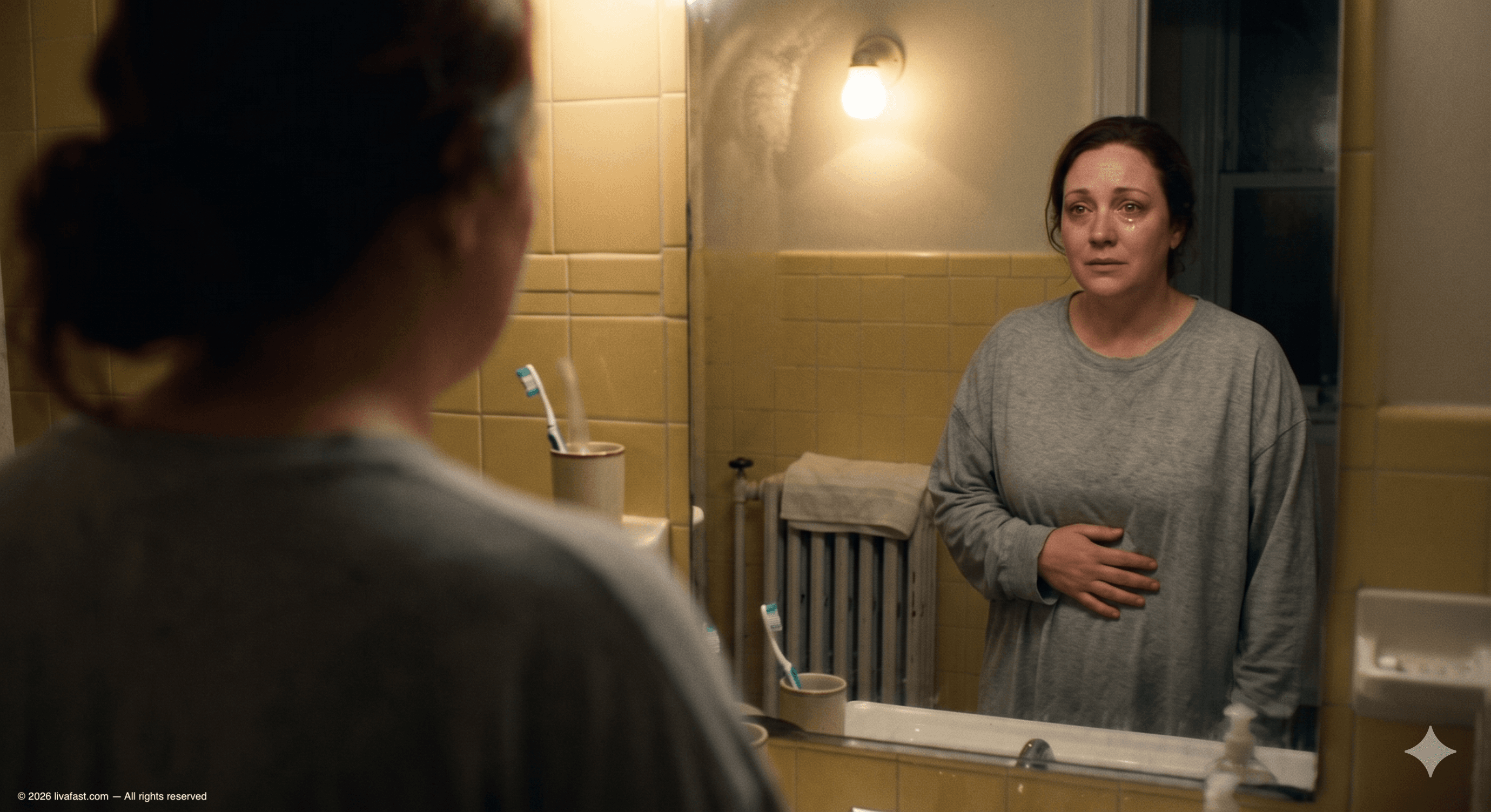
She had not, in any meaningful way, looked at herself in years.
This is something women do not always say out loud, because it sounds like a confession of vanity, when it is in fact the opposite. Ellie had brushed her teeth twice a day at a mirror. She had put on mascara, mornings. She had checked, in passing, whether there was lipstick on her teeth or a tag sticking up at the back of her neck. She had not, since some unmarked Tuesday years ago, looked. She had not stood in front of the mirror in her own bathroom and seen, deliberately, the woman the mirror was showing her.
On the Sunday night before her appointment, she did.
It was eleven o'clock. Sophie was asleep. The apartment was quiet except for the radiator, which was the kind of old radiator that sang — sometimes a low, intermittent hum, sometimes a knock that sounded like someone politely asking to come in. Ellie had been brushing her teeth. She had spat. She had rinsed. She had been about to leave the bathroom, and she had stopped, with her hand on the light switch, and turned, and stood facing the mirror over the sink.
She made herself look.
She was wearing a gray cotton nightshirt that had once been her ex-husband David's and that had, over a decade of washing, become small and soft and gray-on-gray with the ghosts of a logo. The shirt fell to her thighs. Beneath it, she could see — without trying — the curve of her stomach, which had stopped being a stomach and had become, in the way of soft tissue under pressure, two stomachs. The smaller, upper one. The larger, lower one, which rested above the waistband of her underwear like a sigh.
She looked at her face. Her face was — she struggled, for a moment, to find the word. Tired was true, but tired was not enough. Her face was swollen. Beneath her eyes, there were pads of soft fluid, the kind a person gets after weeping or flying or eating too much salt. Her cheeks had an unfamiliar fullness, a wet, slightly pink quality, like cake left in the rain. The skin under her jaw was not loose — it was full. She had, she realized, stopped recognizing her own jawline.
She unbuttoned the gray nightshirt.
She let it fall on the bath mat.
She stood in her underwear and she looked at her body. She looked at her shoulders, which were broad and pale and had a smattering of brown freckles she remembered from being twelve. She looked at her breasts, which were heavier than they had been when she was thirty, which had begun to drag at her chest in a way that felt unfair. She looked at her stomach, which she had been hiding for years, which she had not so much as seen in years, and she traced — with her own fingers — the soft, dark line that ran down the center of it, the linea nigra that had appeared during her pregnancy and faded and then come back, the past two years, in a faint ghost-line she had pretended not to notice.
She looked at the back of her neck. The skin there was darker than the skin on her arms. It had been darker for at least a year. She had always told herself it was a tan that had not faded. She knew now, somewhere in the part of herself that read books and watched documentaries, that it was not a tan.
She turned sideways. She looked at her profile.
The shape of her own body, in the mirror, in the yellow bathroom light, looked like a shape she did not know how to feel about. Not a stranger's shape — a relative's. A second cousin's. A woman she had met once, briefly, at a wedding, and who had been kind to her, and whose name she could not remember.
She did not cry, at first. She just looked. She looked because she had not allowed herself to look in years, and because it seemed important, suddenly, on the night before she would walk into a doctor's office and offer this body up for examination, that she at least know what she was offering.
She lifted her hand and laid it, again, beneath her right rib.
The small ache was there. Patient. Familiar.
"I see you," she said, out loud, to her own body in the mirror. Her voice cracked on the word see. "I see you. I'm sorry. I see you."
She did cry then. Not the held, swallowed crying of the auditorium. The other kind. The kind where the body finally lets a sound out that has been locked in for years. She put her face in her hands and stood in her own bathroom with the radiator humming and her ten-year-old daughter sleeping down the hall, and she wept, quietly, with both palms pressed against her cheeks, and the woman in the mirror wept with her.
When she lifted her face, eventually, the woman in the mirror was still there.
She put the nightshirt back on. She turned off the light. She went to bed.
She did not sleep well — but she slept differently, because she had, for the first time in years, seen. Sometime in the night, she dreamed of her father. He was sitting at a diner counter, and he was drinking a glass of water, and he turned to her — slowly, as if he had been waiting for her to look at him — and he said only one thing.
He said: Don't wait, kid.
She woke at five. The sky outside her window was the color of the inside of a clamshell. She got up. She did not eat a donut. She drank a glass of water. She put on jeans and a soft sweater and her good shoes, and at eight forty-five, she walked into the offices of Dr. Sandra Patel and said, to the woman behind the desk, "I'm Eleanor Marin. I have a nine o'clock."
She sat down in the waiting room. Her hands, in her lap, shook a little. She let them.
Track this in LivaFast
Your FIB-4 score updates automatically from your labs.
