Chapter 5 · The Appointment
The waiting room. The blood draw. A mother's denial on the phone.
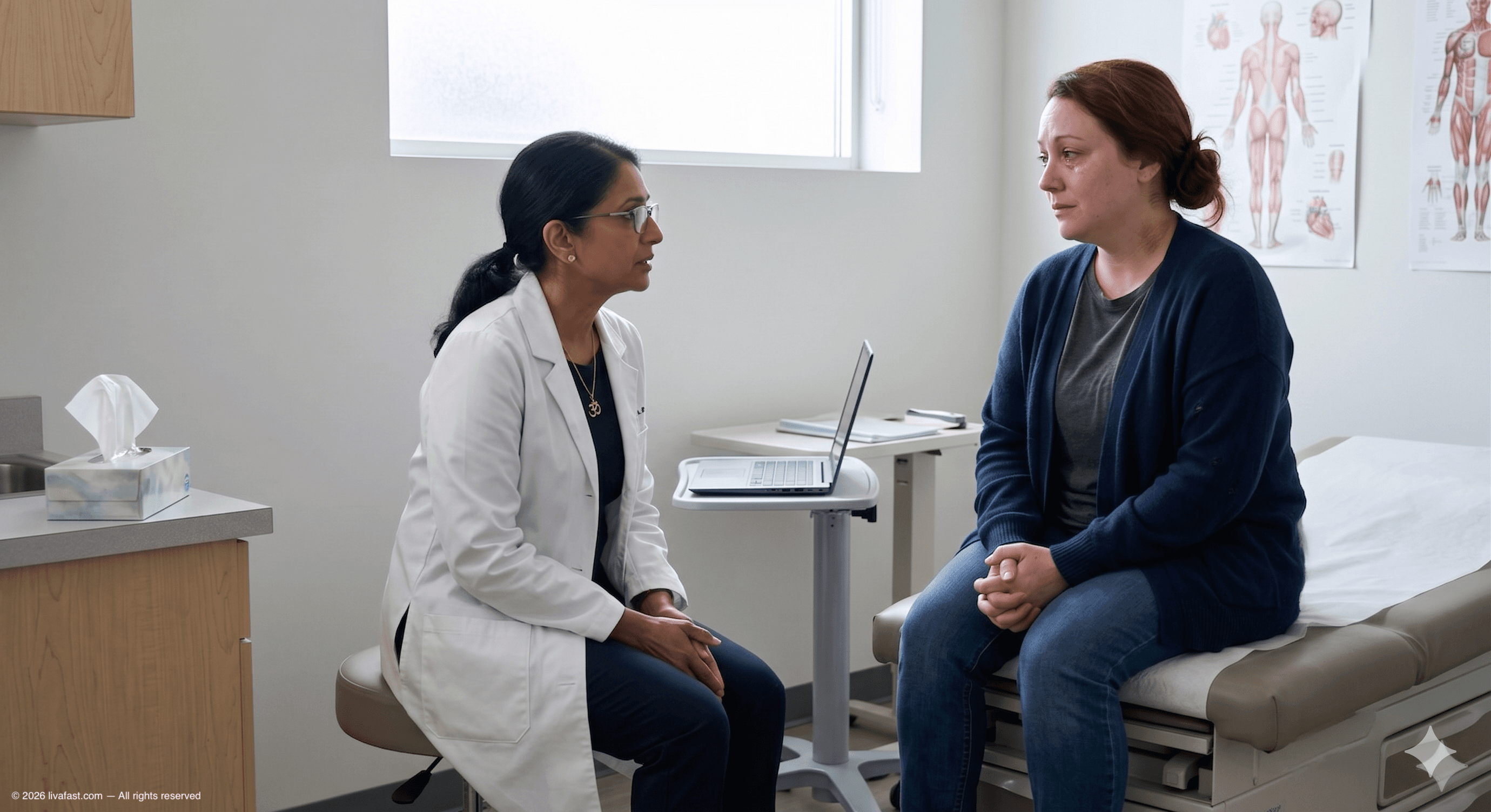
Dr. Sandra Patel was a small, brisk, unsentimental woman who had been Ellie's primary care physician for eight years. She wore narrow steel-framed glasses, and a gold pendant in the shape of an om, and a perpetual expression of mild, patient skepticism, as if she had heard every excuse a body could make and would, today, allow you exactly one.
"Eleanor," she said, when she walked into the exam room. "It's been a minute."
"It has."
"Two and a half years, in fact. According to your chart."
"I know."
Dr. Patel did not scold. She did not need to. She set her laptop on the rolling counter, sat on the wheeled stool, looked at Ellie over the top of her glasses, and said, "Tell me what's been going on."
Ellie had practiced, in the car. She had thought she had a list. She had thought she would say fatigue, abdominal discomfort on the right side, weight gain, occasional dizziness, some swelling. What came out, in the end, was none of these. What came out was: "I don't recognize myself."
Dr. Patel nodded, once. She did not write anything down.
"Tell me more."
So Ellie told her. She told her about the ache under the right rib, which had been there for — yes, six months, at least — and which had begun, the past two weeks, to flare into a burn after meals. She told her about the stairs. She told her about the dizziness in the kitchen, the swelling in her face, the way her bras left red trenches, the way she could no longer climb to the back of the auditorium without pretending to look at her phone. She told her about Pavlina's cake and the way she could not remember tasting it. She told her about her father.
When she was done, she was crying. Not the wet, ragged crying of the bathroom mirror. The other kind, now — the steady, almost calm crying of a person who has finally said something out loud.
Dr. Patel handed her a tissue.
"Eleanor," she said. "Thank you for telling me. We are going to be very thorough today, and I don't want you to be afraid. But I'm going to be honest with you."
Ellie nodded.
"What you're describing — the discomfort under the right rib, the fatigue, the swelling, the metabolic signs — there is a list of things it could be. Some of them are minor. Some of them are not. We're going to draw blood today, and we are going to look at quite a few things. We are going to check your liver. We are going to check your blood sugar. We are going to check your thyroid. We are going to do an EKG, because of the dizziness. And we are going to schedule you for an abdominal ultrasound this week."
"This week."
"This week. Eleanor, when's the last time you had your blood drawn?"
"Two and a half years ago."
"Mm."
That sound — mm — was the only sound of judgment Dr. Patel made all morning. It was not aimed at her. It was aimed at the years.
The blood draw was done by a nurse named Jocelyn Adeyemi, a tall woman with locs pulled into a thick braid down her back and a small gold cross at her throat. She hummed while she tied the tourniquet. She hummed a song Ellie almost recognized — something old, something gospel, something her own grandmother had sung when she was a child.
"You're a good vein," Jocelyn said, after the first tube was filling.
"Thank you."
"Sweetheart," Jocelyn said. She did not look up from the second tube she was switching out. "You doing okay?"
"I think I'm scared."
"Of course you are."
"Should I be?"
Jocelyn paused. She finished the third tube. She labeled it, without hurrying. Then she looked up, and Ellie saw, in her face, a kindness so steady it was almost professional — the kindness of a woman who had drawn the blood of thousands of frightened people and never once flinched at the fear.
"You are not the first person to sit in that chair," Jocelyn said. "And you are not going to be the last. And whatever those numbers say, sweetheart, you came in. You came in. That is the bravest part. The rest, we figure out together."
Ellie nodded. She could not speak.
Jocelyn pressed a cotton ball to the inside of her elbow. "Hold this."
"Thank you."
"You are welcome."
In the parking lot, sitting in her car, Ellie called her mother.
She did this against her better judgment. She did not know why she did it. She did it because Mama Rose was the closest thing she had to a witness — because Marcus would not, in his current state, be able to hear her, and Linh was teaching, and Sam was in a meeting, and there was, truly, no one else in the world who had seen her be afraid since she was nine.
"Eleanor," her mother said. The name came out, as always, in three precise syllables. "Why are you calling at this hour?"
"I'm in the parking lot at Dr. Patel's."
"What did she say?"
"They drew blood. They're sending me for an ultrasound."
There was a small, sharp pause. Then Mama Rose said, in the voice she used when she was already deciding nothing was wrong: "Why, Eleanor? Why an ultrasound? You're not pregnant, are you?"
"No, Mom. I'm not pregnant."
"Then why?"
"My liver, Mom."
The pause this time was longer. Ellie counted her own heartbeats. She got to seven.
"Eleanor," Mama Rose said. "Your liver is fine. You don't drink. You barely have wine at Thanksgiving. Your liver is fine. You have stress. You have a deadline. You have that little girl. You're not your father."
"Mom —"
"You're not your father."
"Mom, I'm not saying I'm — I'm saying my doctor is concerned and she wants to look. That's all I'm saying."
"Doctors are concerned about everything, Eleanor. That's how they make their money."
"Mom."
"It's nothing. It's stress. Don't you give yourself something else to worry about. Don't you dare."
Ellie closed her eyes. She let her mother talk. She knew this voice — this fast, defensive, frightened voice — and she knew that what Mama Rose was hearing, on the other end of the line, was not liver. What Mama Rose was hearing was Steve, age forty-nine, slumped at the diner counter on a Sunday morning. What Mama Rose was hearing was the call from the hospital, the one that came when she was making meatballs. What Mama Rose was hearing was a door, opening, that she had spent twelve years standing against with her shoulder.
"Mom," Ellie said. "I'll call you when I have results. Okay?"
"Eleanor."
"Mom. I have to go."
She hung up. She put both hands on the steering wheel. She looked at the cotton ball, taped to the inside of her elbow, and she pulled the tape free very slowly, and she lifted the cotton, and she saw the small dark dot where Jocelyn's needle had gone in.
She drove home. She did not stop at the corner shop. She did not buy a donut. At lunch, she made a cheese sandwich on the bread she had at home, and she ate it slowly, and she sat at her kitchen table with the unfinished painting of Mister Fox in front of her, and she did not cry, and she did not eat anything else.
That night, when Sophie asked what had happened at the doctor, Ellie said only, "They drew some blood. We'll know more in a few days."
Sophie nodded. She did not press. She brought her mother a glass of water without being asked.
Track this in LivaFast
Your FIB-4 score updates automatically from your labs.
