Chapter 6 · The Phone Call
Numbers that mean nothing and everything: ALT, AST, triglycerides.
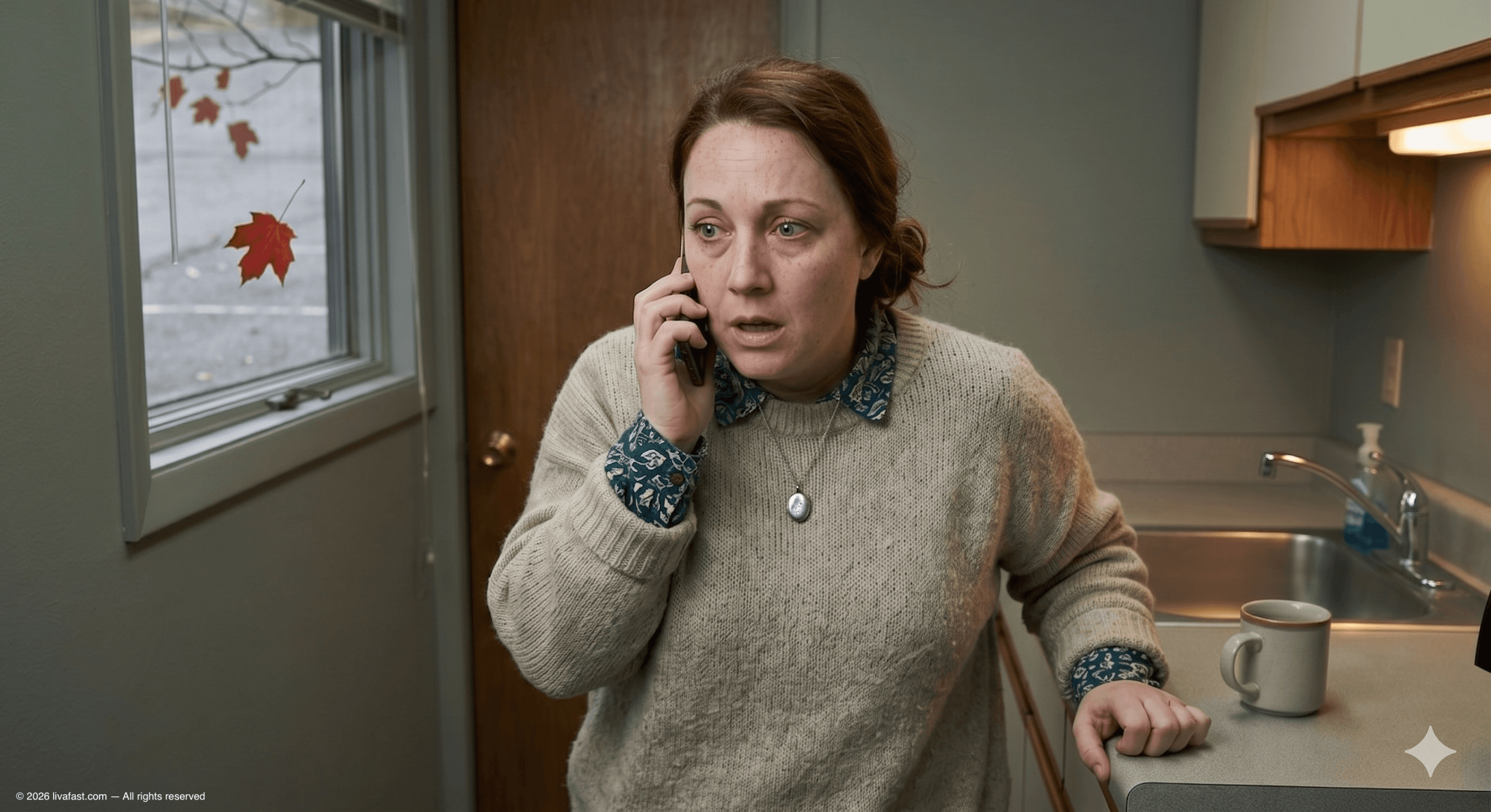
The call came on Wednesday afternoon at three forty-two.
Ellie was at the studio. She had spent the morning unable to focus, opening and closing the same email draft seven times, and she had finally given up and gone for a walk around the block — a slow walk, an embarrassed walk, but a walk — and had come back to her desk and discovered that the small motion of her own body had, briefly, quieted her mind. She was painting a tree when her phone rang.
The number was Dr. Patel's office.
She picked up on the second ring.
"Eleanor, it's Sandra Patel."
It was not Sandra Patel's office. It was Sandra Patel.
This was the first thing Ellie understood. Doctors did not call you themselves with a normal result. Nurses called you with normal results. Doctors called you when they needed you to listen. Ellie set her brush down on the rim of the water glass. She turned away from her desk and walked, instinctively, into the small kitchen at the back of the studio. She closed the door behind her. She leaned against the counter.
"Yes," she said. "I'm here."
"I have your blood work. I want to walk through it with you. Are you in a place where you can talk?"
"Yes."
"Eleanor, your liver enzymes are elevated. Your ALT is one hundred and twelve. Your AST is eighty-four. Your GGT is also elevated. For context — a normal ALT is about thirty-five for a woman, and yours is more than three times that."
Ellie did not say anything.
"Your fasting glucose is one hundred and eighteen, which means you are pre-diabetic. Your hemoglobin A1c is six-point-one. Your triglycerides are two hundred and seventy-four — that's high. Your HDL is low. Your LDL is borderline. Your thyroid is fine. Your iron is fine. Your kidney function is good."
The kitchen had a small window. Outside it, the maple at the far edge of the parking lot had gone from yellow to red sometime in the past three days, and Ellie watched, while her doctor was speaking, a single red leaf detach itself from a branch and fall in a slow, drifting spiral toward the asphalt.
"Eleanor," Dr. Patel said. "Are you with me?"
"I'm with you."
"What I am most concerned about is your liver. The combination of the enzymes, the metabolic markers — the high triglycerides, the pre-diabetes, the central weight gain — points strongly toward what we now call MASLD. Metabolic dysfunction-associated steatotic liver disease. The older name is non-alcoholic fatty liver disease, or NAFLD. It's the most common chronic liver condition in the country. It is, in many people, completely reversible. But I need you to understand that we don't yet know what stage you're in. That's why we're doing the ultrasound."
"When?"
"I have you scheduled for Friday morning at eight. Imaging at Riverside. They have an appointment because of a cancellation."
"Friday."
"Friday. And Eleanor — based on what we find — I am going to refer you to Dr. Aiyana Reyes. She is the hepatologist I trust most. I want you under her care for this. Not mine."
"Okay."
"I want you to listen to me, Eleanor."
"I'm listening."
"This is not a death sentence. Do you hear me? It is not. I am telling you that early because the human brain hears the word liver and goes immediately to the worst place. I have patients in this clinic who, with intervention, fully reverse their MASLD. Fully. I am telling you this because I do not want you to go home tonight and Google for six hours."
Ellie laughed once, sharply, and the laugh broke into a small, embarrassed sob, and Dr. Patel — she could hear it through the phone — Dr. Patel waited, kindly, until she was finished.
"Sandra," Ellie said. "What do I do until Friday?"
"You drink water. You don't drink alcohol — anything at all. You eat as cleanly as you can. You move your body, gently. And you call me, or you call my nurse line, if anything sharply changes — if the pain becomes severe, if you become jaundiced, if you start vomiting. Otherwise, Friday."
"Okay."
"Eleanor."
"Yes."
"I'm glad you came in."
"Me too."
She hung up. She stood in the small kitchen at the back of the studio for what later seemed to her a very long time but was, in fact, four minutes. The red leaf at the bottom of the parking lot had been joined by two others. Somewhere on the other side of the studio door, Sam was on a Zoom call, his voice muffled and amused. The radiator clanked once, politely.
Ellie said, out loud, to no one: "Okay."
She said it three more times, like pushing on a door that had stuck.
"Okay. Okay. Okay."
She washed her hands. She splashed cold water on her face. She dried her face on a paper towel, and she went back to her desk, and she finished the tree.
That night, when Sophie was asleep, she did not Google for six hours. She allowed herself thirty minutes, which was thirty minutes too many. She read the words steatosis, and steatohepatitis, and fibrosis, and cirrhosis, and the word cirrhosis did, as Dr. Patel had warned, send her brain to the place she had been most afraid of going.
She closed the phone. She lay on her back in the dark.
She put one hand on her right side, beneath her rib. She put the other hand over it.
"I'm sorry," she said, again, to the small, faithful, suffering thing inside her. "I see you. I see you. We are going to figure this out."
She did not know yet what figuring it out would look like. But she understood, lying there in the dark, that the figuring out had already begun — that the moment she had spoken into a phone and named what she was afraid of, the figuring out had begun, and that whatever came on Friday morning, it would come now to a woman who had finally, finally turned to face it.
Track this in LivaFast
Your FIB-4 score updates automatically from your labs.
